
Woolly Mammoth
Mammuthus primigenius • "Earth Beast"
The woolly mammoth was an Ice Age relative of living elephants, adapted to cold environments with a dense coat. It lived across parts of northern Eurasia and North America. Researchers can use chemical signals preserved in tusks to study an individual mammoth’s movements and diet.
- Length
- ≈5.5 m
- Weight
- ≈6.0 t
- Diet
- Herbivore
- Danger
- ★★★★★
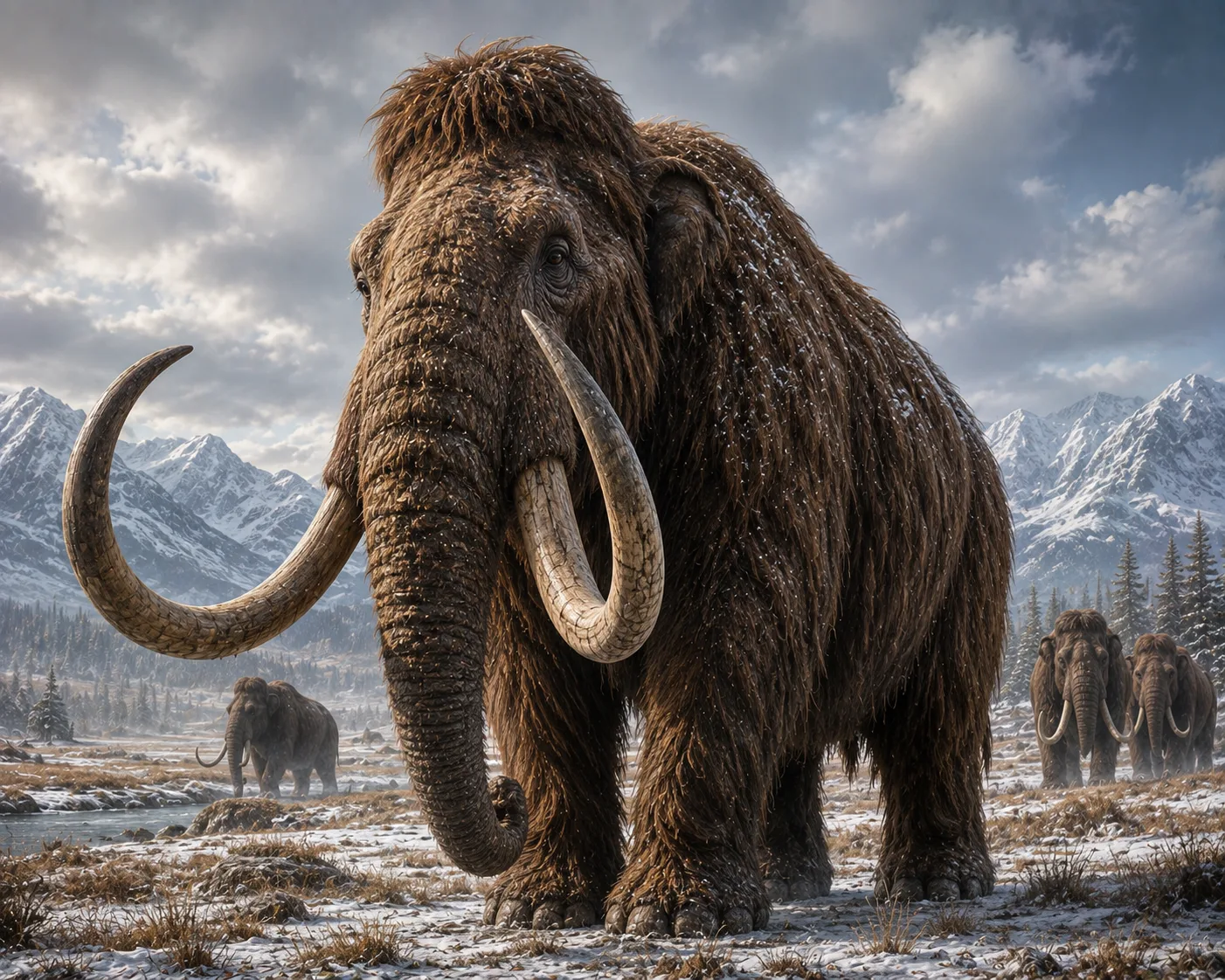
Overview
The woolly mammoth was an Ice Age relative of living elephants, adapted to cold environments with a dense coat. It lived across parts of northern Eurasia and North America. Researchers can use chemical signals preserved in tusks to study an individual mammoth’s movements and diet.
“Isotope analysis of a woolly mammoth tusk has helped researchers reconstruct its movements across prehistoric Alaska.”
Key facts
Strengths
- Adapted to its prehistoric environment
Weaknesses
- Limited fossil evidence for detailed behavior
Natural weapons
- Natural jaws, teeth, or defensive anatomy
Movies vs. science
Myth: Popular media often simplifies prehistoric animal behavior.
Reality: Fossils provide the strongest evidence for anatomy and ecology.
Size & simulator stats
Large adults stood around 2.7–3.4 m at the shoulder and could weigh several tonnes; size varied by population and individual.
- Length
- 5.5 m
- Height
- 3.4 m
- Weight
- 6.0 t
Illustrative simulator values (not measured biology)
See how Woolly Mammoth measures up in the sourced size comparison chart.
Habitat
Cold steppe and tundra regions of northern Eurasia and North America during the Pleistocene.
Northern Eurasia and North America, including Arctic islands where some populations survived late.
Diet
A herbivore that grazed on grasses and other Ice Age vegetation.
Herbivore. It grazed on grasses and other plants of the Ice Age steppe.
Fossils & discovery
First described from Fossil record (Multiple fossil formations).Isotope analysis of a woolly mammoth tusk has helped researchers reconstruct its movements across prehistoric Alaska.
Research sources
- American Museum of Natural History: Mammoth or mastodon?
- American Museum of Natural History: Mammoth tusk research
Sources checked on by the Dinosaurs Names Editorial Team. Editorial policy
Gallery
Related dinosaurs
Battle Arena
Can anything beat Woolly Mammoth?
Send Woolly Mammoth into an illustrative matchup against any other species and compare attack, defense, and bite force.
Fight as Woolly Mammoth