
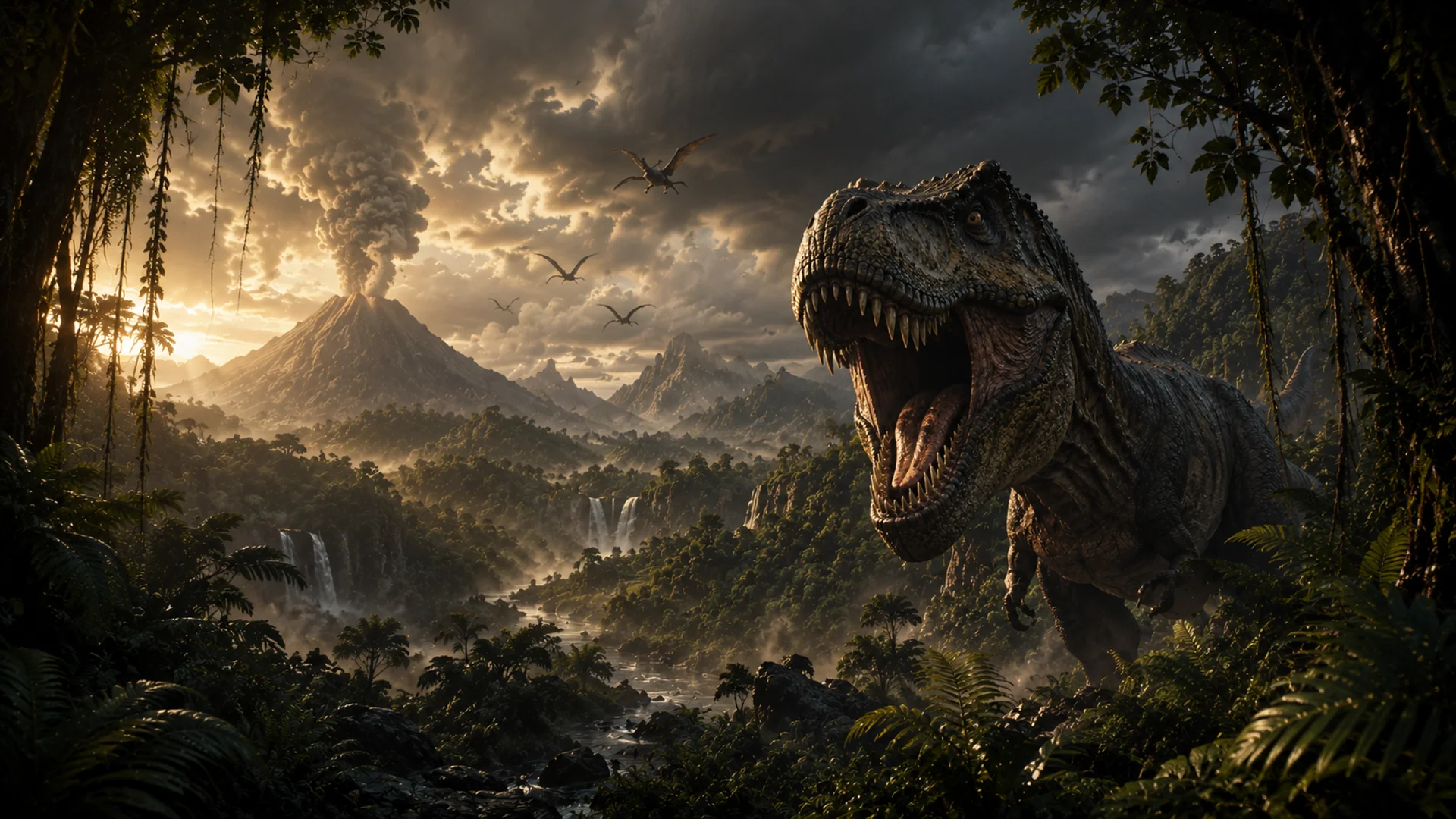
Dinosaurs Names: The Definitive Guide to
Prehistoric Dinosaurs.
Explore evolutionary histories, bone-shattering bite forces, anatomical scale comparisons, and pit apex predators head-to-head in our physics-backed battle simulator.
30+
Triassic to Cretaceous13,500 PSI
Mosasaurus & T-Rex45.0 Tonnes
Brachiosaurus altithorax55 km/h
Carnotaurus sastreiTyrannosaurus Rex vs. Spinosaurus
Who would win in a real prehistoric duel? Our battle algorithm calculates jaw compression, semi-aquatic mobility, mass inertia, and claw slashing radii.
Species of the Day: Tyrannosaurus Rex
The undisputed apex predator of Cretaceous North America. Tyrannosaurus Rex was an evolutionary masterpiece engineered for pure, unadulterated crushing power. Unlike other theropods that possessed knife-like slicing teeth, T-Rex had thick, railroad-spike teeth supported by fused skull bones capable of biting through solid ceratopsian bone and thick osteoderm armor.
- 50-60 Serrated bone-cracking teeth (up to 30 cm / 12 inches including root)
- 1.5-meter reinforced fused nasal skull delivering 12,800 PSI crushing torque
- Heavy counterbalancing muscular tail generating massive rotational momentum
- Binocular stereoscopic vision with superior 3D depth perception
Combat Performance Index
Iconic Prehistoric Dinosaurs
Explore by Mesozoic Time Period
From the emergence of early theropods in the Jurassic to the apex reign of titanosaurs in the Late Cretaceous.
Late Cretaceous
The golden age of titans including T-Rex, Triceratops, Spinosaurus, and Mosasaurus, ending in the K-Pg extinction event.
Early Cretaceous
Flourishing of diverse feathered theropods, early ceratopsians, and colossal sauropods across changing continents.
Late Jurassic
The era of gigantic long-necked sauropods, plated stegosaurs, and swift allosauroid predators.
Early Jurassic
Recovery after Triassic extinction; dinosaurs rapidly diversified to dominate terrestrial niches worldwide.
Dinosaurs Names, Pictures, Fossils, and Real Science
Dinosaurs Names is an interactive guide for anyone who wants to explore the prehistoric world. Use this dinosaurs encyclopedia to discover familiar giants, unusual predators, armored herbivores, flying reptiles, and marine reptiles in one searchable place. Each profile brings together a dinosaur's common name, scientific name, meaning, geological period, habitat, diet, body size, estimated speed, defense, intelligence, and bite force. Whether you are researching a school project, choosing a dinosaur book topic, or simply looking for your next favorite species, the site turns a huge fossil record into clear, useful facts.
The species directory is designed for curious readers who want more than a list of dinosaur names. Filter all dinosaurs by diet, size, category, and time period to compare animals that lived millions of years apart. Read about Triassic pioneers, Jurassic giants, and Late Cretaceous apex predators, then open a detailed dossier for anatomy, behavior, paleogeography, weapons, armor, and discovery history. The collection is a practical starting point for learning how scientists reconstruct a real dinosaur from fossil evidence, while making room for the uncertainty that is part of paleontology.
Looking for dinosaur pictures or a dinosaurs photo? Every profile uses visual references to help you recognize the shape and proportions of the animal. Images work alongside measurements and scale comparisons so a name becomes something you can understand spatially. A fossil is not just a dramatic object in a museum: bones, teeth, trackways, and rock formations can reveal what an animal ate, how it moved, where it lived, and how it fit into an ancient ecosystem. Our fossil record sections connect those discoveries to the species profiles without pretending that every detail is known with certainty.
The guide also answers popular questions about water dinosaurs names. Some prehistoric animals lived in rivers, coastal waters, or open seas, but not every aquatic reptile was technically a dinosaur. Compare piscivorous species and marine reptiles by habitat, body plan, size, and movement to see why paleontologists separate dinosaurs from other Mesozoic animals. These distinctions make the encyclopedia more useful for accurate research and help explain why a real dinosaur such as a theropod should not be grouped casually with every creature that shared its world.
When facts raise a “who would win?” question, open the dinosaur fight simulator. The dinosaur game lets you select opponents, choose a setting, and see a stats-based scenario built from attack power, defense, speed, body mass, intelligence, bite force, and terrain. Try the famous t-rex vs spinosaurus matchup, or create a less predictable battle between a horned defender and an armored rival. Results are educational simulations rather than claims about a documented encounter: behavior, environment, age, health, and chance would all matter in real life. The arena is a playful way to understand how different adaptations affect survival.
Dinosaurs Names brings together the appeal of a dinosaur book, the convenience of a searchable database, and the immediacy of an interactive dinosaur game. Start with a name you already know, browse the complete roster, or explore by the era that interests you most. Along the way, you can learn why a long neck, powerful jaw, sail, horn, club tail, or feathered body evolved and what evidence supports each interpretation. Bookmark a profile for later study, compare species with friends, and use the battle arena to turn facts into memorable questions. The goal is simple: make dinosaurs easier to find, easier to compare, and more fascinating to understand.
A good dinosaur reference should help you ask better questions, not just memorize impressive numbers. Why did some predators develop narrow, slicing teeth while others evolved crushing jaws? How could a massive herbivore support its weight, and why might an armored animal trade speed for protection? The profiles organize these questions around observable traits and fossil clues. You can compare skull shape, locomotion, body mass, defensive anatomy, and habitat before deciding which adaptations mattered most. This makes the site useful for teachers, students, families, and dinosaur fans who want a quick answer as well as readers who want a deeper route into paleontology.
The comparison tools are also a reminder that prehistoric life was diverse. “Dinosaur” describes a major group, not one single body type or lifestyle. A fast small theropod, a four-legged sauropod, a horned ceratopsian, and a plated stegosaur occupied very different ecological roles. The directory lets you move between those forms and see how time, geography, diet, and anatomy shaped evolution. Use the era explorer to connect individual names with the broader Mesozoic story, from early experiments in the Triassic through Jurassic expansion and the changing ecosystems of the Cretaceous.
Every visit can follow a different path: search a name, inspect a dinosaur photo, read the fossil evidence, compare scale, and finish with a friendly arena challenge. That combination keeps the experience approachable while preserving the details that make each species worth studying. It is a living reference for exploring ancient animals with curiosity, context, and a clear line between established evidence and imaginative simulation.
Frequently Asked Questions About Dinosaurs
What are all the dinosaur names?
There are thousands of named dinosaur species, and new discoveries continue to add to the list. The Dinosaurs Names directory organizes a growing collection of documented dinosaurs, including Tyrannosaurus rex, Triceratops, Stegosaurus, Brachiosaurus, Velociraptor, Spinosaurus, Allosaurus, Ankylosaurus, Diplodocus, and many more.
What are the names of the 10 dinosaurs?
Ten well-known dinosaurs are Tyrannosaurus rex, Triceratops, Stegosaurus, Brachiosaurus, Velociraptor, Spinosaurus, Allosaurus, Ankylosaurus, Diplodocus, and Parasaurolophus.
When did dinosaurs go extinct?
Most non-avian dinosaurs went extinct about 66 million years ago, at the end of the Cretaceous Period. Birds are living dinosaurs, so the dinosaur lineage did not disappear completely.
What killed the dinosaurs?
The leading explanation is the Chicxulub asteroid impact, which caused global environmental disruption, including darkness, cooling, wildfires, and food-web collapse. Volcanic activity and climate change may also have increased the stress on ecosystems.
Were dinosaurs real?
Yes. Dinosaurs were real animals supported by an extensive fossil record of bones, teeth, trackways, nests, eggs, feathers, and other traces found on every continent.
Were there any dinosaurs in the world?
Yes. Dinosaurs lived across the ancient world for more than 165 million years, and dinosaur fossils have been discovered on every modern continent.
Is the dinosaur real in history?
Yes. Dinosaurs are part of Earth history, and paleontologists reconstruct their lives from fossils preserved in rocks. Some details remain uncertain because the fossil record is incomplete.
Is dinosaur DNA still alive?
No confirmed dinosaur DNA has survived from the Mesozoic. DNA breaks down over time, but birds are living dinosaur descendants and preserve some dinosaur traits through evolution.
Who found the first dinosaur?
The first scientifically named dinosaur was Megalosaurus, described by William Buckland in 1824. Richard Owen later coined the word Dinosauria in 1842.
How did dinosaurs come on Earth?
Dinosaurs evolved from earlier archosaurs and appeared during the Triassic Period, more than 230 million years ago. They arose through natural evolution, gradually adapting to different habitats and ecological roles.
Is T. rex or Giganotosaurus stronger?
Tyrannosaurus rex was probably stronger overall in bite force and skull construction, while Giganotosaurus was a large and formidable predator with a longer body. Because they lived at different times and no direct encounter occurred, the comparison is an informed estimate rather than a historical fact.
Which dinosaur is stronger than T. rex?
No dinosaur can be proven to be stronger than T. rex in every category. Spinosaurus was longer and some giant sauropods were far heavier, but strength depends on the measure used, such as bite force, body mass, pushing power, or weaponry.
What are the top 5 deadliest dinosaurs?
A reasonable list of dangerous dinosaur predators includes Tyrannosaurus rex, Giganotosaurus, Carcharodontosaurus, Spinosaurus, and Utahraptor. "Deadliest" is not a directly measurable fossil trait, so this ranking reflects size, weapons, hunting adaptations, and likely ecological impact.