
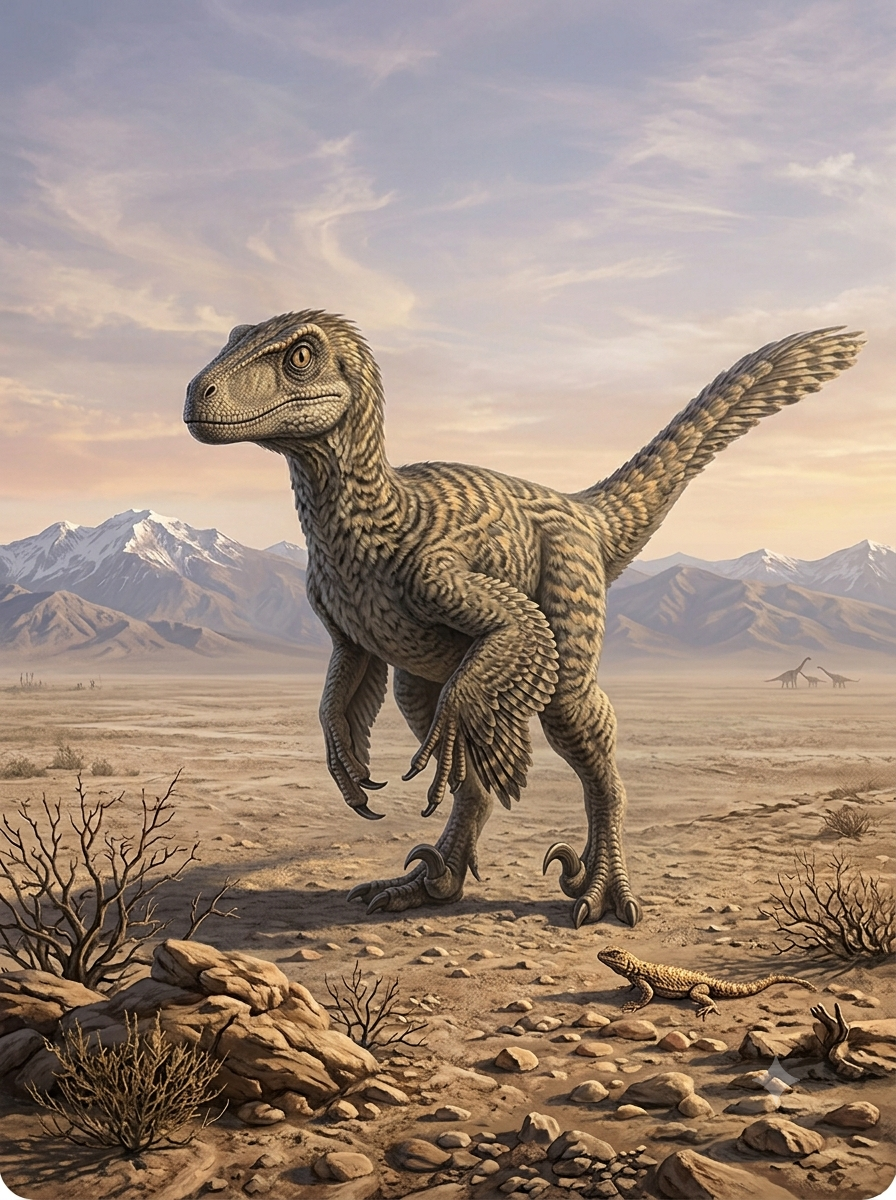
Velociraptor
Velociraptor mongoliensis
Paleobiological Overview & Profile
The feathered speed demon of the prehistoric desert. While popular films oversized them, the true Velociraptor was turkey-sized with a coat of pennaceous feathers, exceptional problem-solving intelligence, and an iconic 9cm sickle claw used for grappling prey.
In 1971, the legendary "Fighting Dinosaurs" fossil was uncovered in the Gobi Desert, capturing a Velociraptor locked in mortal combat with a Protoceratops, buried instantly by a collapsing sandstorm.
True Biological Size Comparison
Anatomical Weapon Systems
Specialized biomechanical adaptations evolved for predatory dominance and defensive survival.
Held off the ground during running to keep it razor sharp; snaps downward with lethal force.
Ossified bone rods along the tail vertebrae allowed the tail to act as a dynamic counterbalance.
Direct bone attachment points for large pennaceous feathers on the forearm.
Complete Weapon Systems:
- ✓9-centimeter razor-sharp sickle claw on second toe (hyper-extensible)
- ✓Feathered aerodynamic stabilizer tail with ossified rod tendons
- ✓Needle-like recurved serrated teeth for throat puncture
- ✓Advanced binocular vision and high encephalization quotient (brain-to-body ratio)
Tactical Combat Playbook
Predatory strategies and survival mechanics against varying classes of prehistoric opponents.
Uses extreme speed and tight turning radius to evade stomps, leaping onto blind spots to distract and harass.
Targets unarmored eyes, throat, and exposed soft tissues through coordinated pack attacks.
High-speed pursuit jumping with feathered tail stabilization to pin fleeing prey.
Key Biological Advantages
- +Highest agility, turning response, and sprint acceleration in class
- +Sophisticated pack hunting tactics and problem-solving cognitive index
- +Lethal toe claw capable of pinning prey and severing major windpipes
- +Feathered thermal insulation allowing high-energy endurance pursuits
Tactical Weaknesses
- -Low individual body mass (18 kg) susceptible to heavy crushing blows
- -Cannot penetrate heavy osteoderm armor on its own
- -Fragile hollow bird-like skeletal structure
Pop-Culture Myth vs. Scientific Evidence
"Depicted as 2-meter-tall scaly reptilian monsters without feathers."
Velociraptor was 0.5m tall at the hips and had direct fossil quill knobs proving full feathered wings and plumage.
Combat Rating Index
Habitat & Diet Specialization
Arid desert dunes, seasonal oasis streams, and dry scrublands of Central Asia.
Hunted small ceratopsians (Protoceratops), lizards, primitive mammals, and juvenile dinosaurs.
Discovery Provenance
- Fossil Localities
- Mongolia & China
- First Excavation
- 1923 AD
- Primary Formation
- Djadokhta Formation (Flaming Cliffs, Gobi Desert)
- Geological Epoch
- Late Cretaceous