
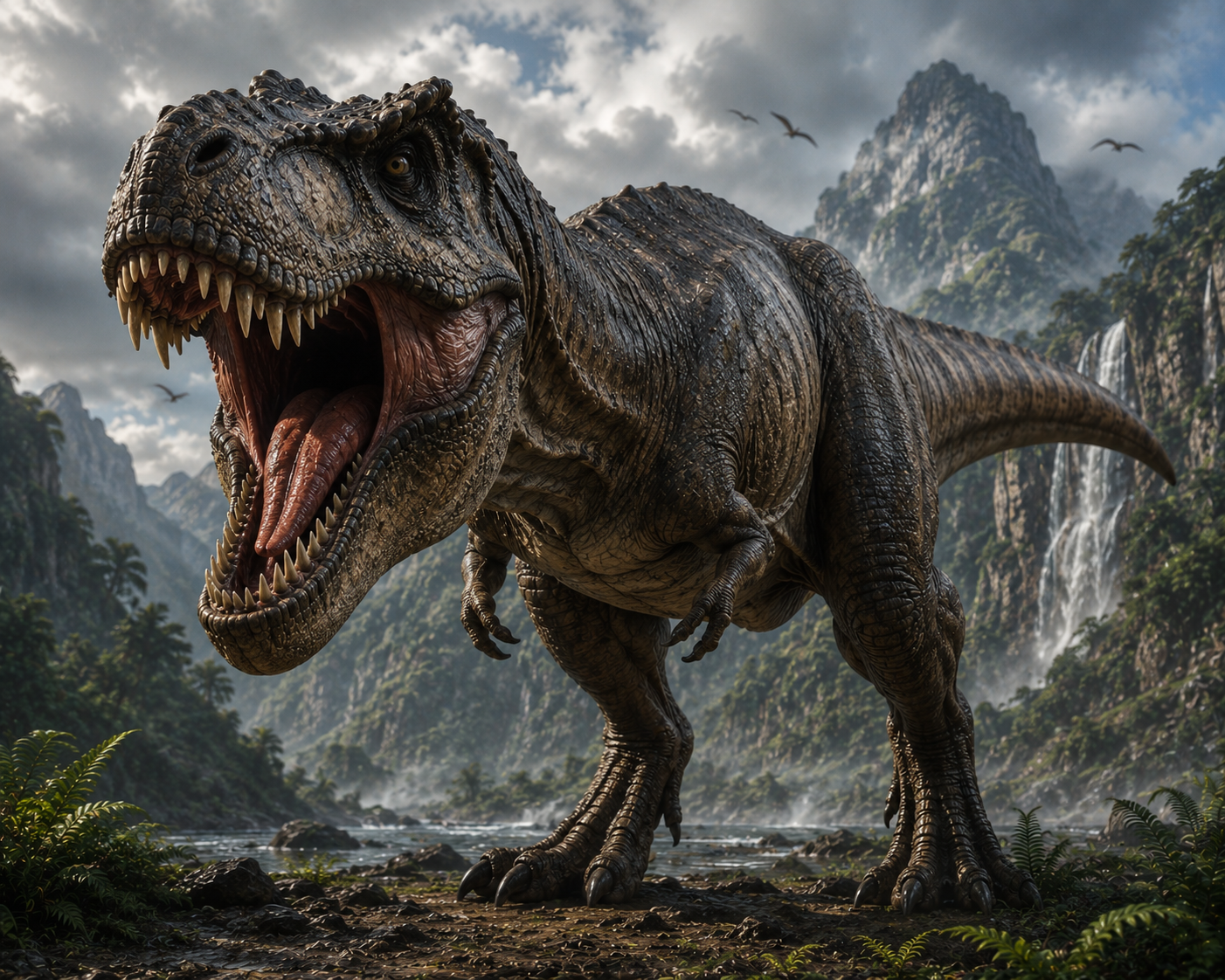
Tyrannosaurus Rex
Tyrannosaurus rex
Paleobiological Overview & Profile
The undisputed apex predator of Cretaceous North America. Tyrannosaurus Rex was an evolutionary masterpiece engineered for pure, unadulterated crushing power. Unlike other theropods that possessed knife-like slicing teeth, T-Rex had thick, railroad-spike teeth supported by fused skull bones capable of biting through solid ceratopsian bone and thick osteoderm armor.
The largest complete T-Rex skeleton ever discovered, nicknamed "Sue" (FMNH PR 2081), measures 12.3 meters long, stood 3.8 meters tall at the hips, and survived severe combat injuries including broken ribs and an infected jaw.
True Biological Size Comparison
Anatomical Weapon Systems
Specialized biomechanical adaptations evolved for predatory dominance and defensive survival.
Fused skull architecture eliminates elastic flex, channeling 100% of muscular jaw force directly into tooth tips.
Thick, oval-cross-section teeth with serrated edges designed for piercing and crushing rather than pure slicing.
Enormous tail muscles anchored to the femur provided tremendous sprinting thrust and stability.
Complete Weapon Systems:
- ✓50-60 Serrated bone-cracking teeth (up to 30 cm / 12 inches including root)
- ✓1.5-meter reinforced fused nasal skull delivering 12,800 PSI crushing torque
- ✓Heavy counterbalancing muscular tail generating massive rotational momentum
- ✓Binocular stereoscopic vision with superior 3D depth perception
Tactical Combat Playbook
Predatory strategies and survival mechanics against varying classes of prehistoric opponents.
Uses heavy skull to deliver bone-crushing bites to the opponent’s neck or rostrum, using superior bite force and body mass to pin and crush.
Bites directly through the bony neck frill or flank armor of Triceratops and Ankylosaurs to crush internal organs and break spinal columns.
Utilizes ambush concealment in dense forest tree lines, exploding into a short-range 27-32 km/h charge to grab prey before an extended pursuit is needed.
Key Biological Advantages
- +Unrivaled bone-crushing jaw pressure that shatters armor
- +Binocular vision comparable to modern birds of prey
- +Enormous olfactory bulb giving it the keenest sense of smell of any theropod
- +Thick, dense neck musculature built to withstand violent thrashing
Tactical Weaknesses
- -Reduced two-fingered forelimbs useless in active combat grab maneuvers
- -Large mass results in high inertia and slower high-speed turning radius
- -High caloric energy expenditure requires large, frequent meat intake
Pop-Culture Myth vs. Scientific Evidence
"Jurassic Park depicted T-Rex vision as motion-based ("Keep still, it cannot see us if we do not move")."
Paleontological brain scans show T-Rex had extraordinary binocular 3D vision with a 55-degree visual field (better than modern hawks) plus an elite sense of smell.
Combat Rating Index
Habitat & Diet Specialization
Lush subtropical floodplain forests, river deltas, and dense coastal wetlands with towering gymnosperms, palms, and rich fern understories.
Hunted giant ceratopsians (Triceratops), massive hadrosaurs (Edmontosaurus), and armored nodosaurs; also acted as an opportunistic scavenger capable of consuming entire carcasses including marrow bones.
Discovery Provenance
- Fossil Localities
- United States & Canada
- First Excavation
- 1902 AD
- Primary Formation
- Hell Creek Formation (Montana, South Dakota, Wyoming)
- Geological Epoch
- Late Cretaceous