
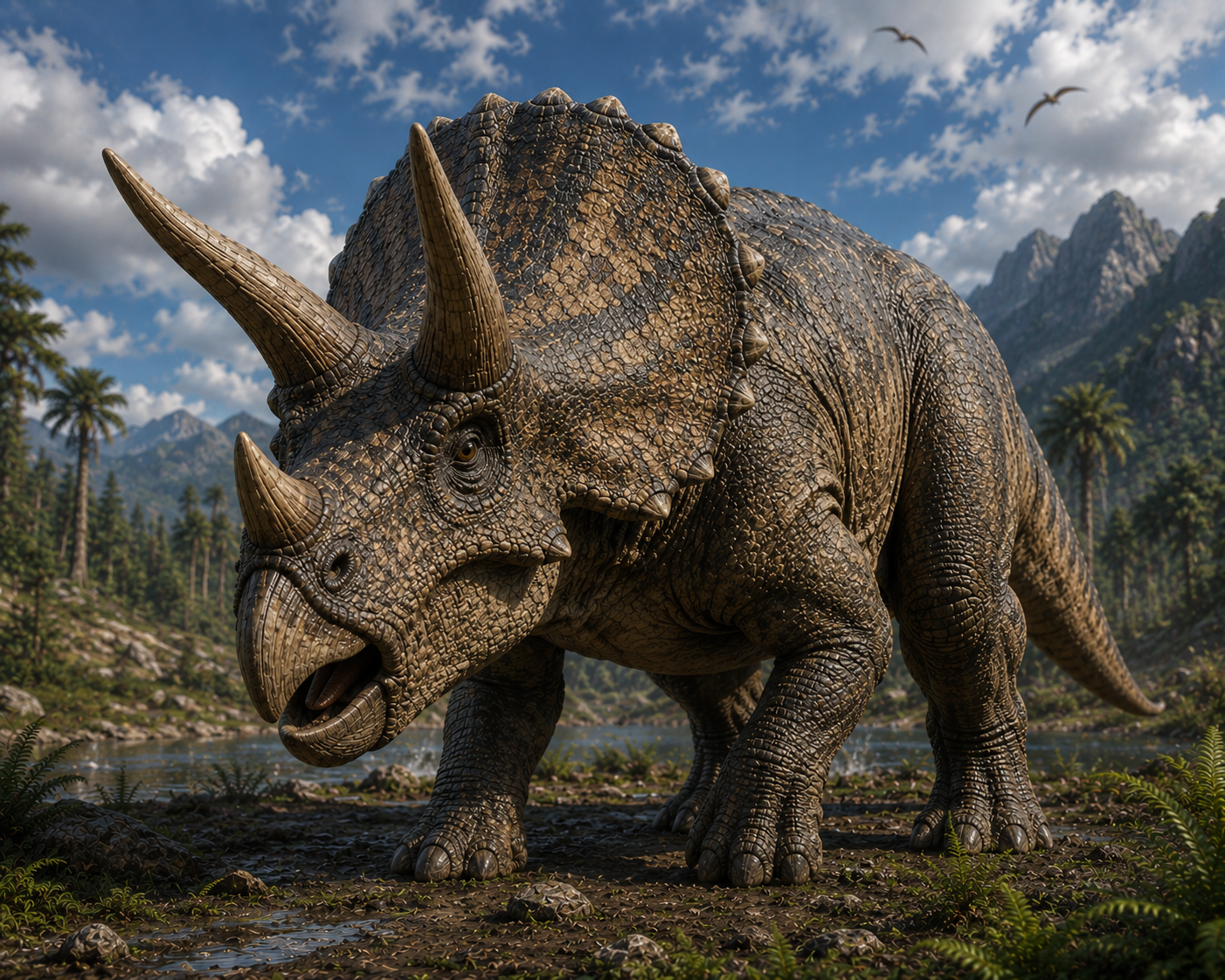
Triceratops
Triceratops horridus
Paleobiological Overview & Profile
The heavyweight armored battering ram of the late Cretaceous. Triceratops was one of the largest ceratopsians ever known, possessing a solid bone frill and brow horns that could pierce through predator flesh with the force of an armored truck.
Multiple fossilized Triceratops frills exhibit healed circular puncture wounds that match the precise diameter and cross-section of T-Rex teeth, proving they frequently clashed and survived.
True Biological Size Comparison
Anatomical Weapon Systems
Specialized biomechanical adaptations evolved for predatory dominance and defensive survival.
Unlike other ceratopsians that had large openings (fenestrae) in their frills, Triceratops had a solid, thick bone shield.
Solid bone cores covered in live keratin (like rhino horns), providing both toughness and sharpness.
A sharp, scissor-like keratin beak backed by a self-sharpening dental battery.
Complete Weapon Systems:
- ✓Dual 1.0-meter pointed brow horns made of solid bone core and keratin sheath
- ✓Nasal horn and massive solid bone neck frill (up to 2 meters wide)
- ✓Sharp slicing beak backed by a battery of hundreds of shearing teeth
Tactical Combat Playbook
Predatory strategies and survival mechanics against varying classes of prehistoric opponents.
Maintains strict frontal orientation with frill raised, tracking predator movement and launching short-range counter-charges to impale legs and abdomen.
Locks horns in territorial or mating dominance displays, using mass leverage to twist opponents off balance.
Swings heavy horned head horizontally in wide defensive arcs to sweep away small flank attackers.
Key Biological Advantages
- +Impenetrable solid bone neck frill that shields vulnerable carotid arteries
- +Massive 9-tonne kinetic charge capable of piercing apex theropod chests
- +Low center of gravity making it extremely difficult to topple or flip
- +Sharp shearing beak that can sever limbs in close quarters
Tactical Weaknesses
- -Exposed flanks and vulnerable hindquarters once an opponent gets behind the frill
- -Lower turning agility once committed to a high-speed charge
- -Heavy skull requires immense neck muscle exertion during prolonged headbutting duels
Pop-Culture Myth vs. Scientific Evidence
"Popular media often portrays Triceratops as slow, docile, and easily hunted by single predators."
Triceratops was an aggressive, active fighter weighing up to 9 tonnes capable of sprinting at 30 km/h, easily capable of fatally goring a T-Rex.
Combat Rating Index
Habitat & Diet Specialization
Dense coastal plains, forested floodplains, and open woodland savannahs of North America.
Consumed tough, fibrous prehistoric cycads, palms, ferns, and low-growing angiosperms using its specialized slicing dental battery.
Discovery Provenance
- Fossil Localities
- United States
- First Excavation
- 1887 AD
- Primary Formation
- Lance & Hell Creek Formation (Montana, Wyoming, Colorado)
- Geological Epoch
- Late Cretaceous