
Titanoboa
Titanoboa cerrejonensis • "Titan Boa"
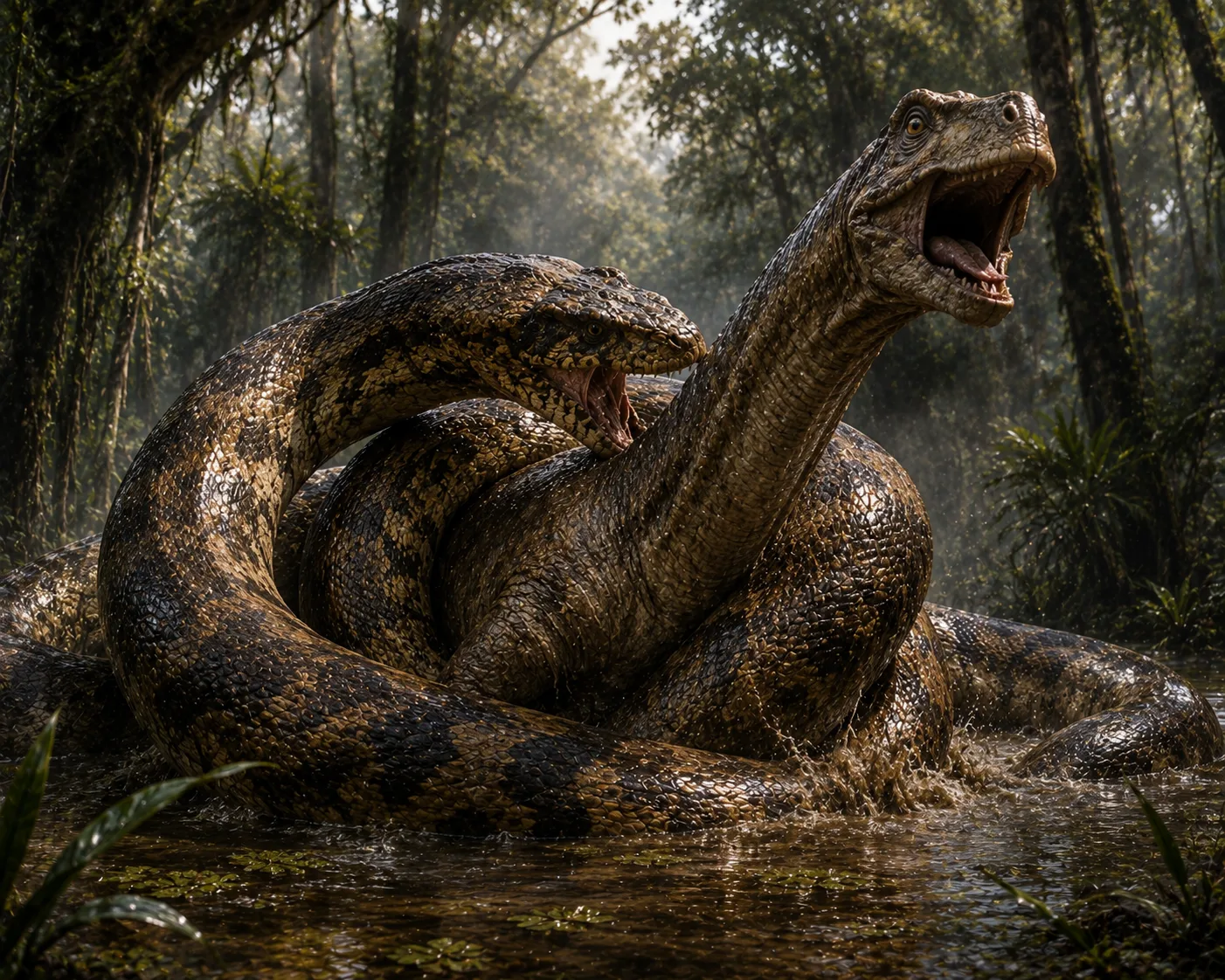
Titanoboa cerrejonensis was a giant snake from the Paleocene, after the extinction of the non-avian dinosaurs. Its fossils were discovered in Colombia’s Cerrejón coal mine, where fossil plants and animals preserve evidence of an ancient tropical ecosystem.
- Length
- ≈13 m
- Weight
- ≈1.1 t
- Diet
- Carnivore
- Danger
- ★★★★★
Overview
Titanoboa cerrejonensis was a giant snake from the Paleocene, after the extinction of the non-avian dinosaurs. Its fossils were discovered in Colombia’s Cerrejón coal mine, where fossil plants and animals preserve evidence of an ancient tropical ecosystem.
“The Cerrejón fossils place Titanoboa in a rainforest environment about 60 million years ago. Its size is reconstructed from vertebrae rather than a complete skeleton.”
Key facts
Strengths
- Adapted to its prehistoric environment
Weaknesses
- Limited fossil evidence for detailed behavior
Natural weapons
- Natural jaws, teeth, or defensive anatomy
Movies vs. science
Myth: Popular media often simplifies prehistoric animal behavior.
Reality: Fossils provide the strongest evidence for anatomy and ecology.
Size & simulator stats
Estimated at about 13 m long from vertebrae; this is a reconstruction because no complete skeleton is known.
- Length
- 13 m
- Height
- 1.2 m
- Weight
- 1.1 t
Illustrative simulator values (not measured biology)
See how Titanoboa measures up in the sourced size comparison chart.
Habitat
Paleocene tropical rainforest of what is now northern Colombia.
Tropical forests and wetlands of present-day northern Colombia; fossils were found in the Cerrejón Formation.
Diet
A large constricting snake; the associated fossil community includes fish and other animals that could have served as prey.
Carnivore. It was a large constricting snake; the exact prey is inferred from its anatomy and associated fossils.
Fossils & discovery
First described from Fossil record (Multiple fossil formations).The Cerrejón fossils place Titanoboa in a rainforest environment about 60 million years ago. Its size is reconstructed from vertebrae rather than a complete skeleton.
Research sources
Sources checked on by the Dinosaurs Names Editorial Team. Editorial policy
Gallery
Battle Arena
Can anything beat Titanoboa?
Send Titanoboa into an illustrative matchup against any other species and compare attack, defense, and bite force.
Fight as Titanoboa