
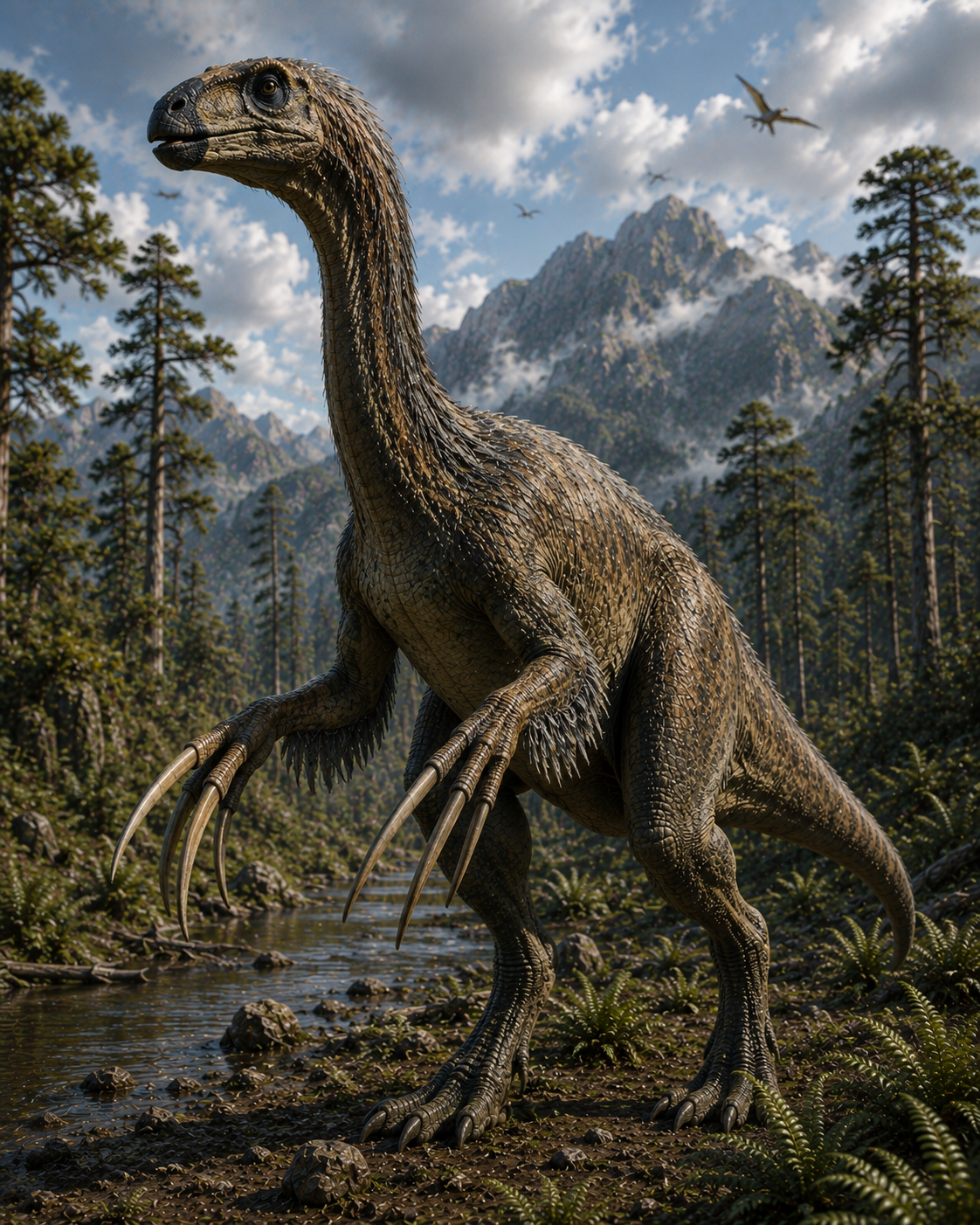
Therizinosaurus
Therizinosaurus cheloniformis
Paleobiological Overview & Profile
The bizarre scythe master of the Cretaceous. Despite belonging to the theropod family, Therizinosaurus evolved into a giant herbivore sporting 3-foot-long curved claws used to strip vegetation and defend against giant predators like Tarbosaurus.
When its giant claws were first discovered in 1948, Russian paleontologists mistakenly thought they belonged to a gigantic 15-meter sea turtle that used them to harvest seaweed.
True Biological Size Comparison
Anatomical Weapon Systems
Specialized biomechanical adaptations evolved for predatory dominance and defensive survival.
Longest claws in Earth history, gently curved and sharply pointed.
Thick shoulder bones anchoring powerful arm flexor muscles.
Enlarged gut for fermenting plant matter.
Complete Weapon Systems:
- ✓1.0-meter meter-long scythe-shaped hand claws (longest of any known animal)
- ✓2.5-meter long muscular forelimbs with enormous reach
- ✓Heavy rotund body mass with thick feather insulation
Tactical Combat Playbook
Predatory strategies and survival mechanics against varying classes of prehistoric opponents.
Rears up to full 5-meter height, executing wide horizontal scythe sweeps that keep predators at bay.
Maintains territorial boundary using claw reach.
Sweeps forelimbs across ground level to deter flankers.
Key Biological Advantages
- +Unmatched claw slashing reach (over 3 meters total arm span)
- +Can disembowel apex predators with a single horizontal scythe swipe
- +Tall bipedal browsing stature intimidating approaching carnivores
Tactical Weaknesses
- -Herbivorous beak unsuitable for aggressive bite combat
- -Slow sprint locomotion speed
Pop-Culture Myth vs. Scientific Evidence
"Shown in Jurassic World Dominion as an aggressive blind stalker."
Had normal stereoscopic vision and was an herbivorous browser that only used its claws in self-defense.
Combat Rating Index
Habitat & Diet Specialization
Dense riverine forests and lush floodplains of Cretaceous Central Asia.
Herbivorous browser feeding on high tree foliage, bushes, and seeds using its long reach.
Discovery Provenance
- Fossil Localities
- Mongolia
- First Excavation
- 1948 AD
- Primary Formation
- Nemegt Formation (Gobi Desert)
- Geological Epoch
- Late Cretaceous