
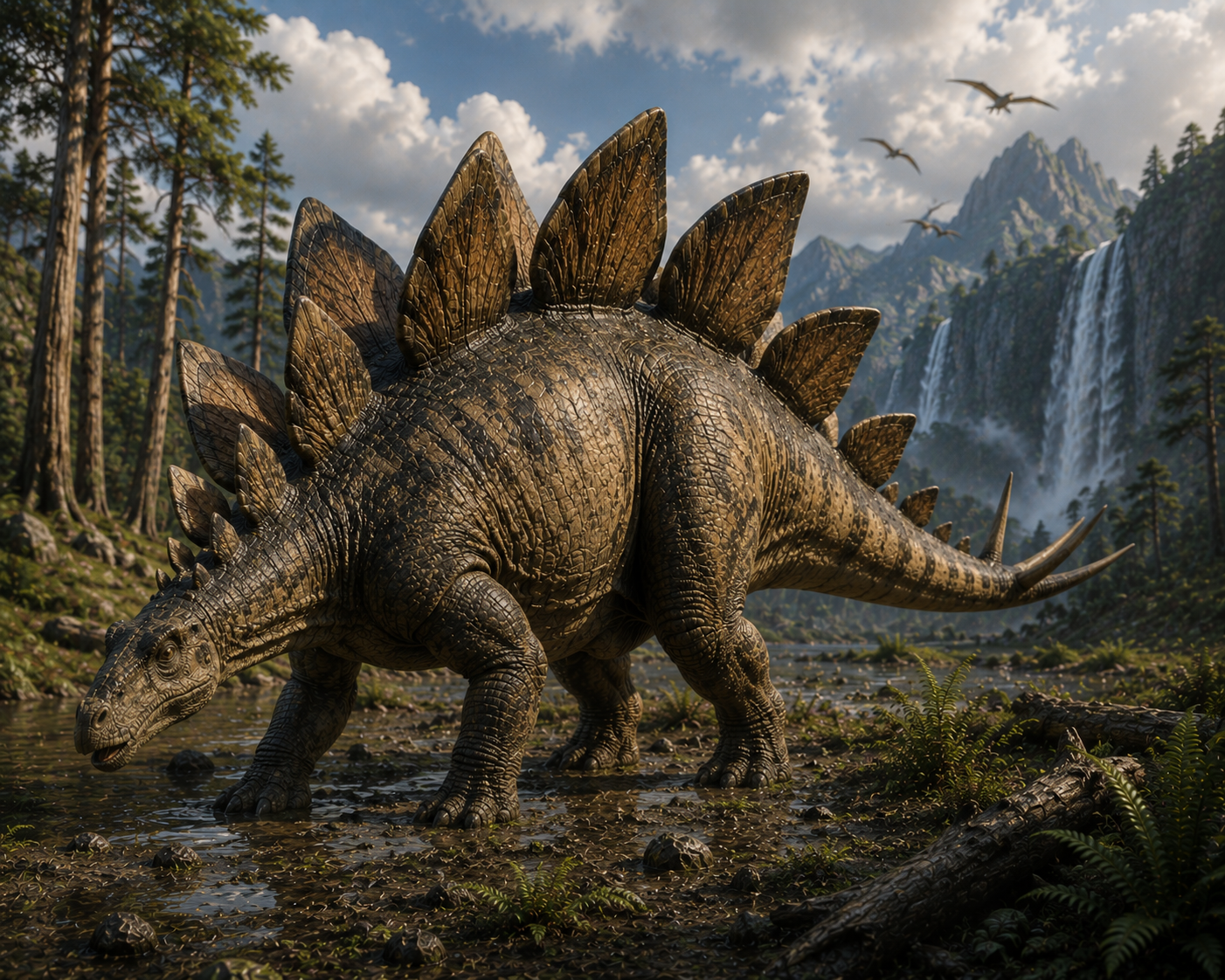
Stegosaurus
Stegosaurus stenops
Paleobiological Overview & Profile
The iconic plated fortress of the Jurassic. Stegosaurus defended itself against ferocious predators like Allosaurus using its fearsome four-spiked tail (the "thagomizer"), which could swing with pinpoint accuracy to pierce predator bones.
The tail spikes are formally called the "Thagomizer" in paleontology, a term coined by cartoonist Gary Larson in a 1982 Far Side comic that was subsequently adopted by scientists.
True Biological Size Comparison
Anatomical Weapon Systems
Specialized biomechanical adaptations evolved for predatory dominance and defensive survival.
Four thick, conical spikes protruding horizontally from the end of a flexible tail.
Large alternating bony plates embedded in skin, rich in blood vessel channels.
Dozens of small coin-sized bony beads embedded directly in the throat skin.
Complete Weapon Systems:
- ✓Thagomizer: Four 1.0-meter pointed bony tail spikes
- ✓17-22 alternating upright vascular dorsal plates for intimidation and thermoregulation
- ✓Heavily armored throat protected by dense osteoderm ossicles
Tactical Combat Playbook
Predatory strategies and survival mechanics against varying classes of prehistoric opponents.
Pivots rear toward predator and unleashes high-velocity thagomizer swings aimed at the predator’s thighs and pelvic girdle.
Maintains defensive perimeter with tail spikes held ready.
Continuous low-level tail sweeping to prevent surrounding flank maneuvers.
Key Biological Advantages
- +Lethal thagomizer tail strike with flexible horizontal whip arc
- +Dorsal plates provide visual intimidation and thermal blood flushing
- +Low center of gravity with armored throat protection against neck-biters
Tactical Weaknesses
- -Small walnut-sized brain (low cognitive intelligence)
- -Vulnerable flank and soft underbelly if out-maneuvered
- -Low running sprint speed
Pop-Culture Myth vs. Scientific Evidence
"Popular myth claimed Stegosaurus had a "second brain" in its hip."
The hip cavity held an enlarged glycogen body that stored energy, not a second thinking brain.
Combat Rating Index
Habitat & Diet Specialization
Semi-arid floodplain savannas and open conifer woodlands of Jurassic North America.
Low browser eating ferns, horsetails, mosses, and cycads using a small beak and leaf-shaped cheek teeth.
Discovery Provenance
- Fossil Localities
- United States & Portugal
- First Excavation
- 1877 AD
- Primary Formation
- Morrison Formation (Colorado, Wyoming, Utah)
- Geological Epoch
- Late Jurassic