
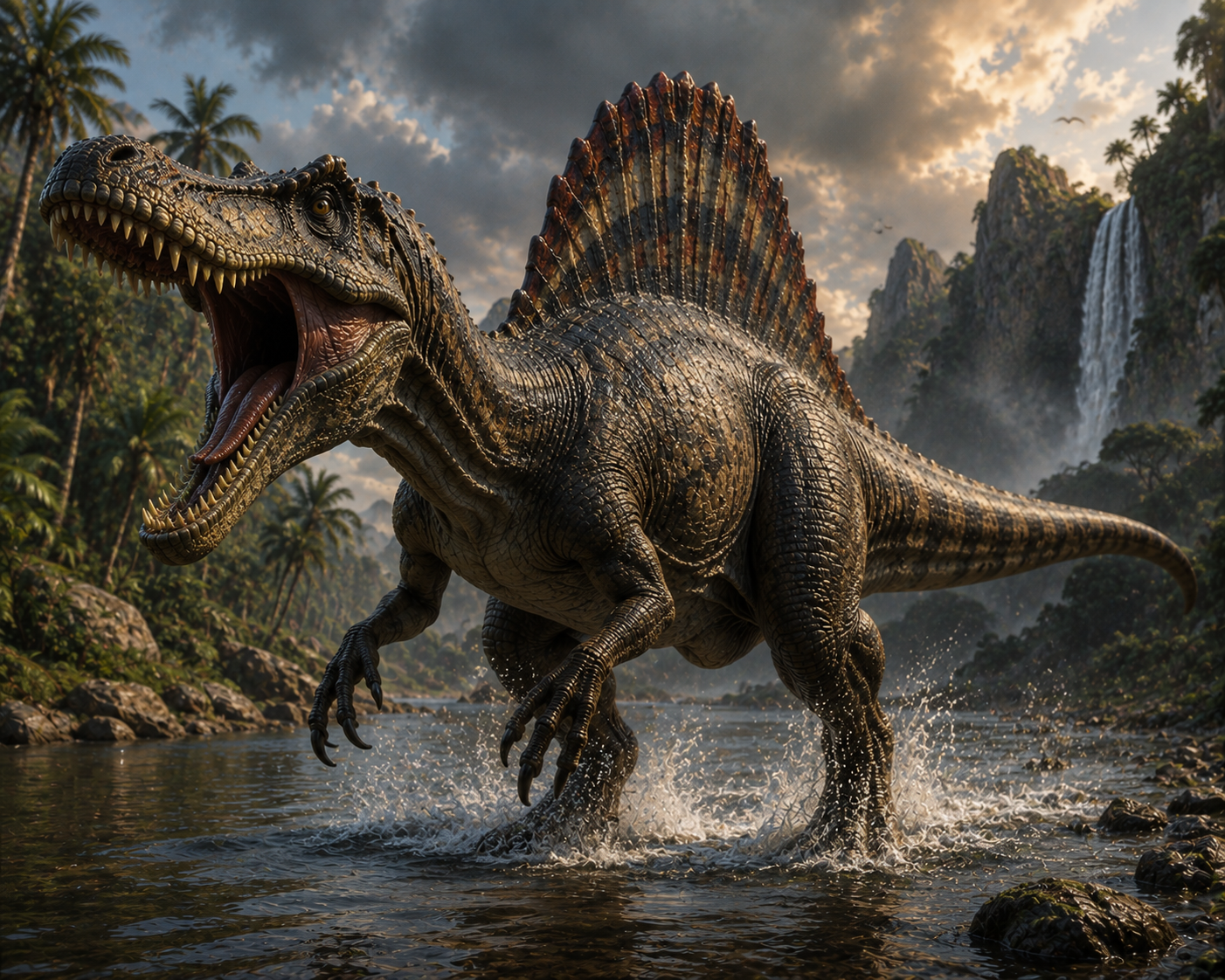
Spinosaurus
Spinosaurus aegyptiacus
Paleobiological Overview & Profile
The giant river leviathan of Cretaceous North Africa. Spinosaurus was longer and heavier than T-Rex, adapted for a semi-aquatic lifestyle with dense bones for buoyancy control, a crocodile-like snout, and a flexible paddle tail that propelled it through ancient river systems.
The original 1912 Spinosaurus holotype fossils stored in the Paleontological Museum in Munich were destroyed during a British RAF bombing raid on Munich in April 1944.
True Biological Size Comparison
Anatomical Weapon Systems
Specialized biomechanical adaptations evolved for predatory dominance and defensive survival.
Tall neural spines on the caudal vertebrae created a flexible, paddle-like tail fin.
Robust arms armed with massive, curved 30cm thumb claws capable of gripping and tearing.
Small openings in the snout bone housed pressure-sensitive nerve endings.
Complete Weapon Systems:
- ✓Conical interlocking teeth adapted for impaling struggling prey
- ✓Giant 2.0-meter tall neural spine dorsal sail
- ✓Massive muscular forelimbs equipped with 30cm curved sickle hand claws
- ✓Paddle-like laterally compressed tail providing powerful aquatic propulsion
Tactical Combat Playbook
Predatory strategies and survival mechanics against varying classes of prehistoric opponents.
Uses powerful 30cm claws to grapple and deflect strikes while dragging the adversary into deep water where its swimming mechanics provide lethal superiority.
Uses elongated reach and hooking claws to flip or bypass thick frontal shields, targeting vulnerable throat and flank areas.
Stationary aquatic ambush using neurovascular snout sensors to detect water displacement before snapping shut with interlocking conical teeth.
Key Biological Advantages
- +Longest predatory dinosaur in history (15 meters long)
- +Absolute dominance in aquatic and riverine wetland environments
- +Devastating multi-taloned front arm slash attacks with massive reach
- +Pressure-sensing neurovascular pits in the snout to detect submerged movement
Tactical Weaknesses
- -Vulnerable dorsal sail structure containing elongated vascular vertebrae
- -Less bone-crushing jaw torque compared to tyrannosaurids (optimized for grip/impale)
- -Slightly lower agility on dry terrestrial plains due to paddle tail and shorter hind legs
Pop-Culture Myth vs. Scientific Evidence
"Jurassic Park III portrayed Spinosaurus as a fully terrestrial hyper-bipedal hunter capable of snapping a T-Rex neck on land."
Spinosaurus was semi-aquatic with dense bones, short hind legs, and a broad paddle tail, reigning supreme in water rather than dry upland terrain.
Combat Rating Index
Habitat & Diet Specialization
Expansive mangrove river deltas, tidal mudflats, and swampy estuaries teeming with giant coelacanths, sawfish, and prehistoric crocodylomorphs.
Hunted giant prehistoric fish like Onchopristis (8-meter sawfish), Mawsonia (giant coelacanth), juvenile crocodyliforms, and medium-sized land dinosaurs drinking at the water’s edge.
Discovery Provenance
- Fossil Localities
- Egypt & Morocco
- First Excavation
- 1912 AD
- Primary Formation
- Bahariya Formation & Kem Kem Beds
- Geological Epoch
- Late Cretaceous