
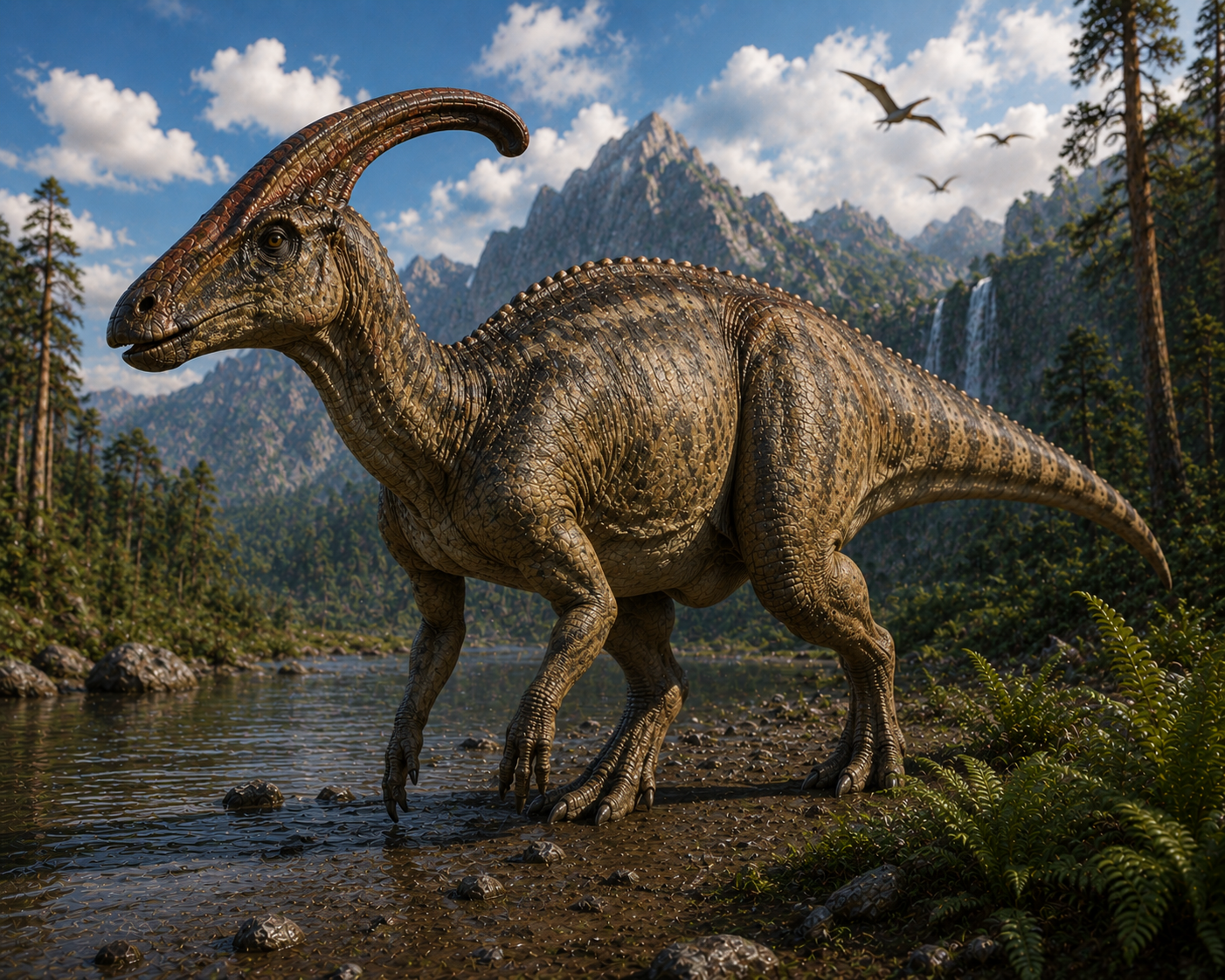
Parasaurolophus
Parasaurolophus walkeri
Paleobiological Overview & Profile
The sonic trumpeter of the dinosaur world. Parasaurolophus possessed a 6-foot hollow bone crest connected to its nasal passages, functioning like a prehistoric trombone to emit resonant low-frequency calls.
Scientists CT-scanned a fossil crest and ran computer acoustic simulations, creating an authentic audio recording of the booming foghorn call it produced 75 million years ago.
True Biological Size Comparison
Anatomical Weapon Systems
Specialized biomechanical adaptations evolved for predatory dominance and defensive survival.
Hollow bone tube containing looped nasal passages.
Can walk on all fours to feed or run on two legs for high-speed evasion.
Tall neural spines providing strong swimming and defensive balance.
Complete Weapon Systems:
- ✓1.8-meter hollow curved cranial crest used for low-frequency acoustic blasts
- ✓Powerful muscular hindquarters capable of bipedal escape sprints
- ✓Hundreds of grinding cheek teeth forming a dental battery
Tactical Combat Playbook
Predatory strategies and survival mechanics against varying classes of prehistoric opponents.
Emits deafening low-frequency sonic calls to alert herd and disorient predator, fleeing at high speed.
Shares peaceful foraging territory.
Uses body mass and speed to avoid confrontation.
Key Biological Advantages
- +Long-range acoustic herd warning communication (audible for miles)
- +High sprint stamina on two or four legs
- +Keen panoramic vision and coordinated herd defense tactics
Tactical Weaknesses
- -Lacks sharp claws or horns for direct lethal offense
- -Fragile hollow cranial crest susceptible to fractures
Pop-Culture Myth vs. Scientific Evidence
"Sometimes depicted as an aquatic animal that used its crest as a snorkel."
The crest was closed at the tip and served strictly as an acoustic resonating chamber.
Combat Rating Index
Habitat & Diet Specialization
Lush coastal floodplains, swamp forests, and river deltas of North America.
Herbivore feeding on pine needles, twigs, leaves, and seeds with grinding dental battery.
Discovery Provenance
- Fossil Localities
- Canada & United States
- First Excavation
- 1920 AD
- Primary Formation
- Dinosaur Park Formation (Alberta) & Kaiparowits Formation (Utah)
- Geological Epoch
- Late Cretaceous