
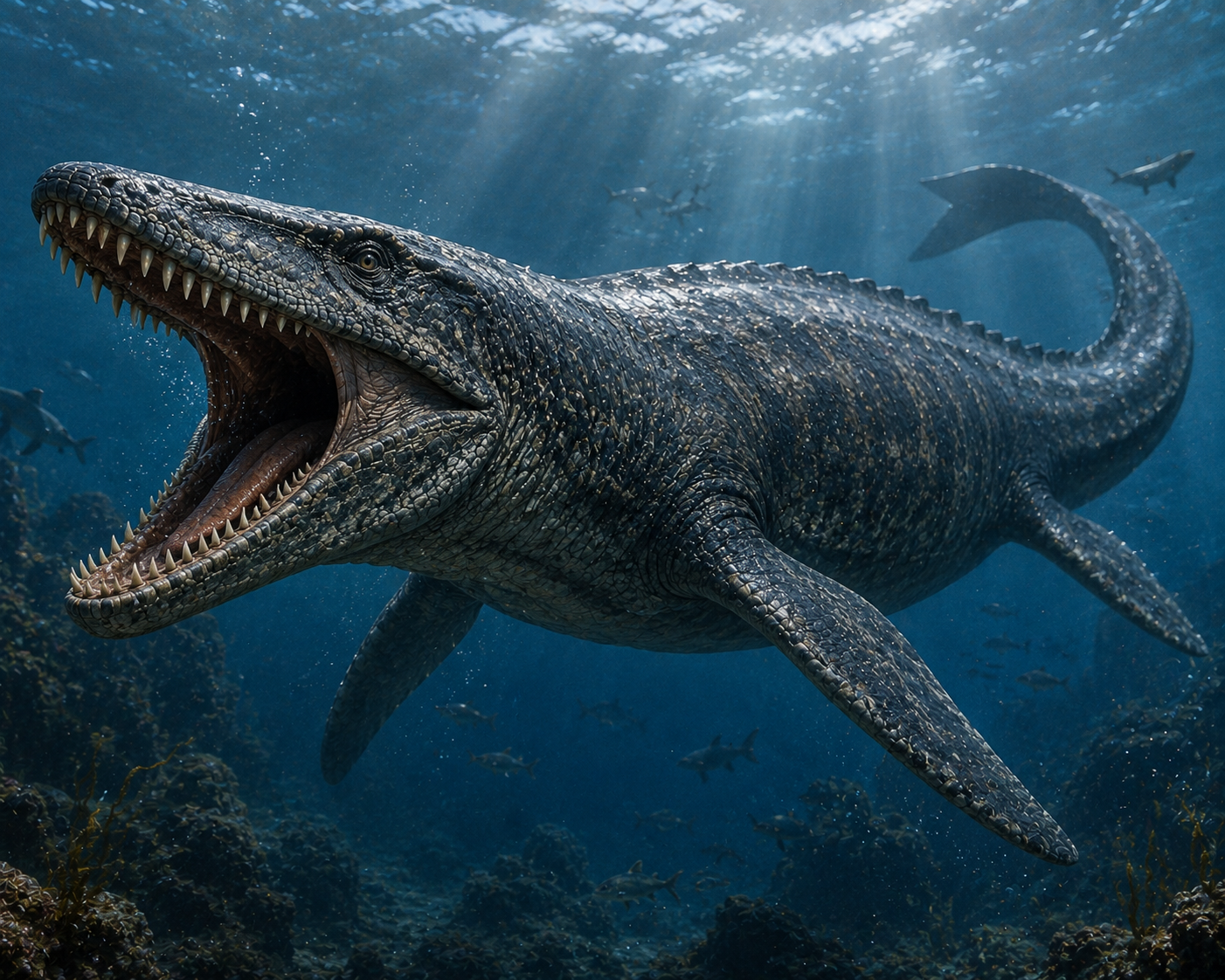
Mosasaurus
Mosasaurus hoffmannii
Paleobiological Overview & Profile
The oceanic leviathan of the Late Cretaceous. Mosasaurus was a gigantic marine squamate closely related to modern monitor lizards and snakes, ruling the prehistoric Western Interior Seaway.
The first Mosasaurus skull discovered in 1780 in a limestone quarry near Maastricht was considered so valuable that French revolutionary forces bombarded the city to capture the specimen.
True Biological Size Comparison
Anatomical Weapon Systems
Specialized biomechanical adaptations evolved for predatory dominance and defensive survival.
A second internal set of teeth on the roof of the mouth.
Two-lobed crescent tail fin similar to modern sharks.
Hyperphalangic paddle limbs providing precise underwater steering.
Complete Weapon Systems:
- ✓Dual row of pterygoid teeth in the upper palate to prevent prey escape
- ✓Powerful crescent tail fin generating explosive ambush thrust
- ✓Massive crushing jaws able to swallow plesiosaurs and giant turtles whole
Tactical Combat Playbook
Predatory strategies and survival mechanics against varying classes of prehistoric opponents.
Strikes from below in water, clamping jaws onto vital organs and using barrel-roll maneuvers.
Crushes through thick turtle shells and ammonite carapaces with 13,500 PSI bite torque.
Uses hydrodynamic tail fin for burst acceleration to ambush fast-swimming prey.
Key Biological Advantages
- +Absolute marine apex dominance
- +Crushing jaw bite force (13,500 PSI) with secondary throat teeth
- +Explosive vertical ambush acceleration from the oceanic abyss
Tactical Weaknesses
- -Completely helpless on dry land
- -Air-breathing reptile that must periodically surface
Pop-Culture Myth vs. Scientific Evidence
"Jurassic World portrayed it as an oversized 25-meter blue whale titan."
Real Mosasaurus reached a realistic 17 meters and 14 tonnes—still the supreme marine predator of its era.
Combat Rating Index
Habitat & Diet Specialization
Warm, shallow epicontinental seas, coastal estuaries, and open oceanic waters.
Hunted giant sea turtles (Archelon), plesiosaurs, ammonites, sharks, and birds.
Discovery Provenance
- Fossil Localities
- Netherlands, North America, Europe
- First Excavation
- 1764 AD
- Primary Formation
- Maastricht Formation (Netherlands)
- Geological Epoch
- Late Cretaceous