
Iguanodon
Iguanodon bernissartensis • "Iguana Tooth"
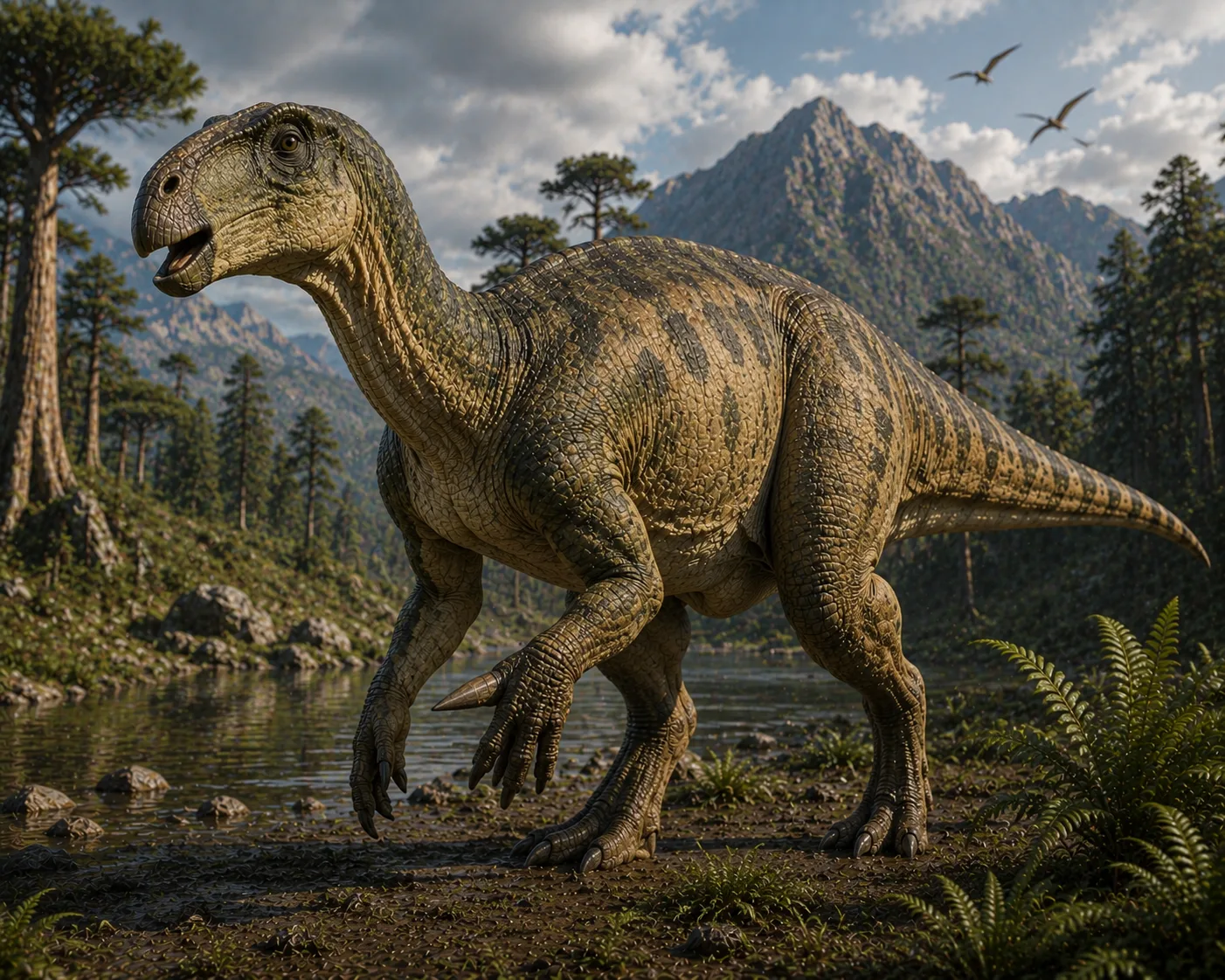
Iguanodon was a large plant-eating ornithopod that lived in Europe during the Early Cretaceous. Its fossils helped establish that large extinct reptiles had once lived on Earth, and its anatomy shows it could move on two legs or four.
- Length
- ≈10 m
- Weight
- ≈5.0 t
- Diet
- Herbivore
- Danger
- ★★★★★
Overview
Iguanodon was a large plant-eating ornithopod that lived in Europe during the Early Cretaceous. Its fossils helped establish that large extinct reptiles had once lived on Earth, and its anatomy shows it could move on two legs or four.
“The first evidence was a set of teeth found in Sussex in 1822. Its hand had a large thumb spike, likely useful for defense.”
Key facts
Strengths
- Adapted to its prehistoric environment
Weaknesses
- Limited fossil evidence for detailed behavior
Natural weapons
- Natural jaws, teeth, or defensive anatomy
Movies vs. science
Myth: Popular media often simplifies prehistoric animal behavior.
Reality: Fossils provide the strongest evidence for anatomy and ecology.
Size & simulator stats
About 10 m long and an estimated 4 tonnes in the Natural History Museum reference.
- Length
- 10 m
- Height
- 4 m
- Weight
- 5.0 t
Illustrative simulator values (not measured biology)
See how Iguanodon measures up in the sourced size comparison chart.
Habitat
Early Cretaceous Europe. Important fossils have been found in England and at Bernissart in Belgium.
Europe, including present-day Belgium and England.
Diet
A herbivore with a beak and rows of cheek teeth for processing plant material.
Herbivore. It had a beak and chewing cheek teeth for eating plant material.
Fossils & discovery
First described from Fossil record (Multiple fossil formations).The first evidence was a set of teeth found in Sussex in 1822. Its hand had a large thumb spike, likely useful for defense.
Research sources
Sources checked on by the Dinosaurs Names Editorial Team. Editorial policy
Gallery
Related dinosaurs
Battle Arena
Can anything beat Iguanodon?
Send Iguanodon into an illustrative matchup against any other species and compare attack, defense, and bite force.
Fight as Iguanodon