
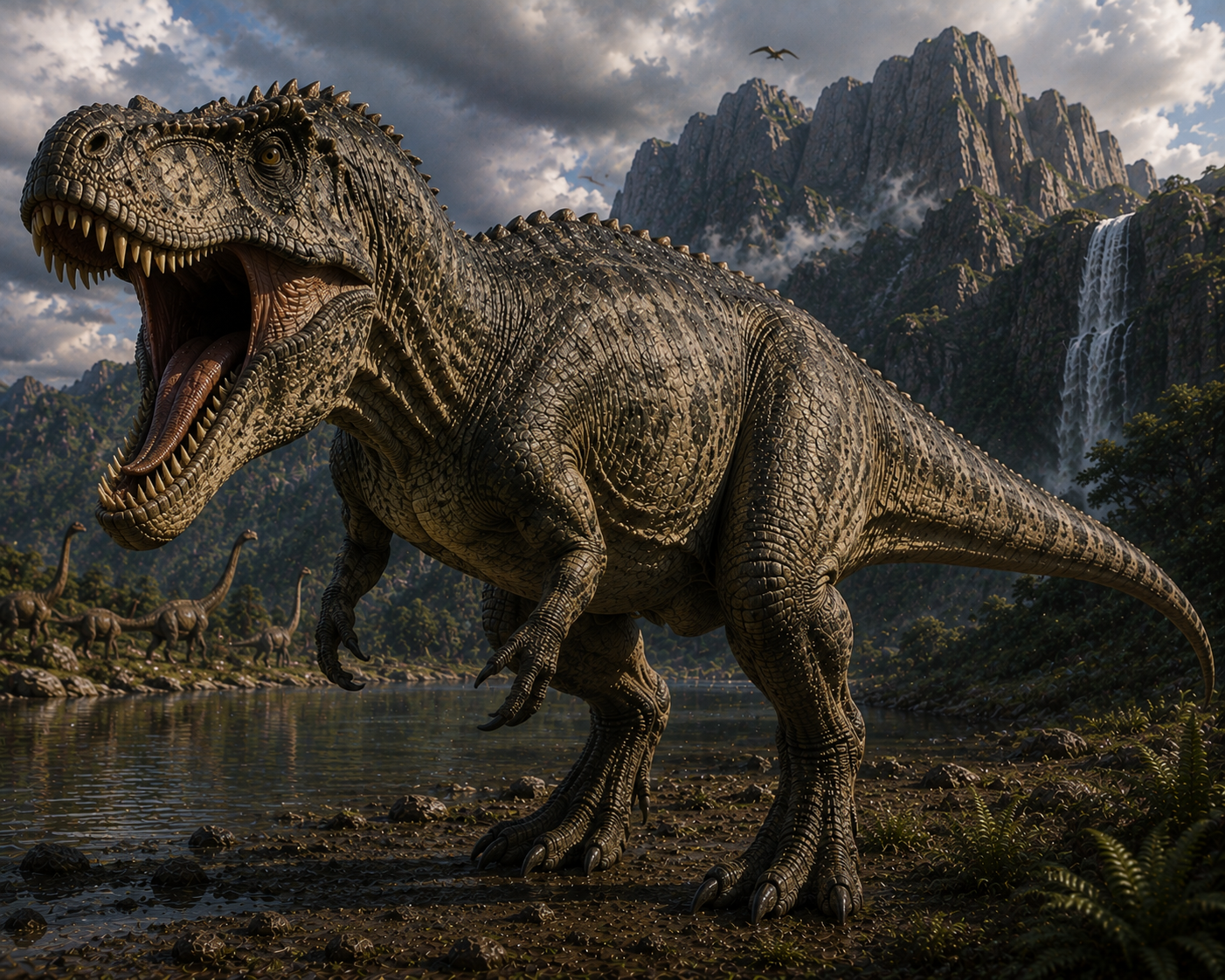
Giganotosaurus
Giganotosaurus carolinii
Paleobiological Overview & Profile
The giant carcharodontosaurid ruler of prehistoric South America. Giganotosaurus was longer than T-Rex and specialized in taking down colossal titanosaurs like Argentinosaurus using pack coordination and razor-blade teeth that caused catastrophic blood loss.
Discovered in 1993 by an amateur fossil hunter named Rubén Carolini, who spotted a giant fossilized shin bone sticking out of the Patagonian desert while riding a dune buggy.
True Biological Size Comparison
Anatomical Weapon Systems
Specialized biomechanical adaptations evolved for predatory dominance and defensive survival.
Flat, recurved teeth with fine microscopic serrations that sliced through flesh like surgical scalpels.
Lightened by large skull openings (fenestrae) to allow rapid, whiplash-like bite snapping.
Powerful hindlimb mechanics allowing an 8.5-tonne predator to reach speeds of up to 32 km/h.
Complete Weapon Systems:
- ✓8-inch flat blade-like serrated slicing teeth (carcharodontosaurid design)
- ✓1.6-meter skull with wide cutting jaw sweep
- ✓Muscular legs capable of maintaining steady pursuit sprint speeds
Tactical Combat Playbook
Predatory strategies and survival mechanics against varying classes of prehistoric opponents.
Uses superior sprint speed and reach to deliver rapid slashing bites to the opponent’s flanks while circling out of range of counter-bites.
Uses blade teeth to slice through exposed skin and tendons behind armor plates.
Maintains steady pursuit pace, wearing down target stamina before delivering a fatal neck slice.
Key Biological Advantages
- +Slicing bite designed for inflicting massive hemorrhagic wounds on giant sauropods
- +High straight-line speed for a 8.5-tonne apex predator
- +Longer body length than most T-Rex specimens
- +Pack-hunting capability against gigantic Argentinosaurus herds
Tactical Weaknesses
- -Lower jaw bite compression compared to tyrannosaurids (relies on slicing, not bone crushing)
- -Narrower skull structure susceptible to heavy lateral impact trauma
- -Less stereoscopic binocular vision depth perception
Pop-Culture Myth vs. Scientific Evidence
"Jurassic World Dominion labeled it "the biggest carnivore the world has ever seen" and an indestructible monster."
While colossal (13.2m), Spinosaurus was longer (15m) and T-Rex had significantly more bone-crushing jaw mass.
Combat Rating Index
Habitat & Diet Specialization
Arid scrublands, braided river valleys, and open floodplain savannahs of Cretaceous South America.
Hunted gigantic titanosaurian sauropods (Argentinosaurus, Andesaurus) and medium-sized ornithopods.
Discovery Provenance
- Fossil Localities
- Argentina
- First Excavation
- 1993 AD
- Primary Formation
- Candeleros Formation (Patagonia)
- Geological Epoch
- Late Cretaceous