
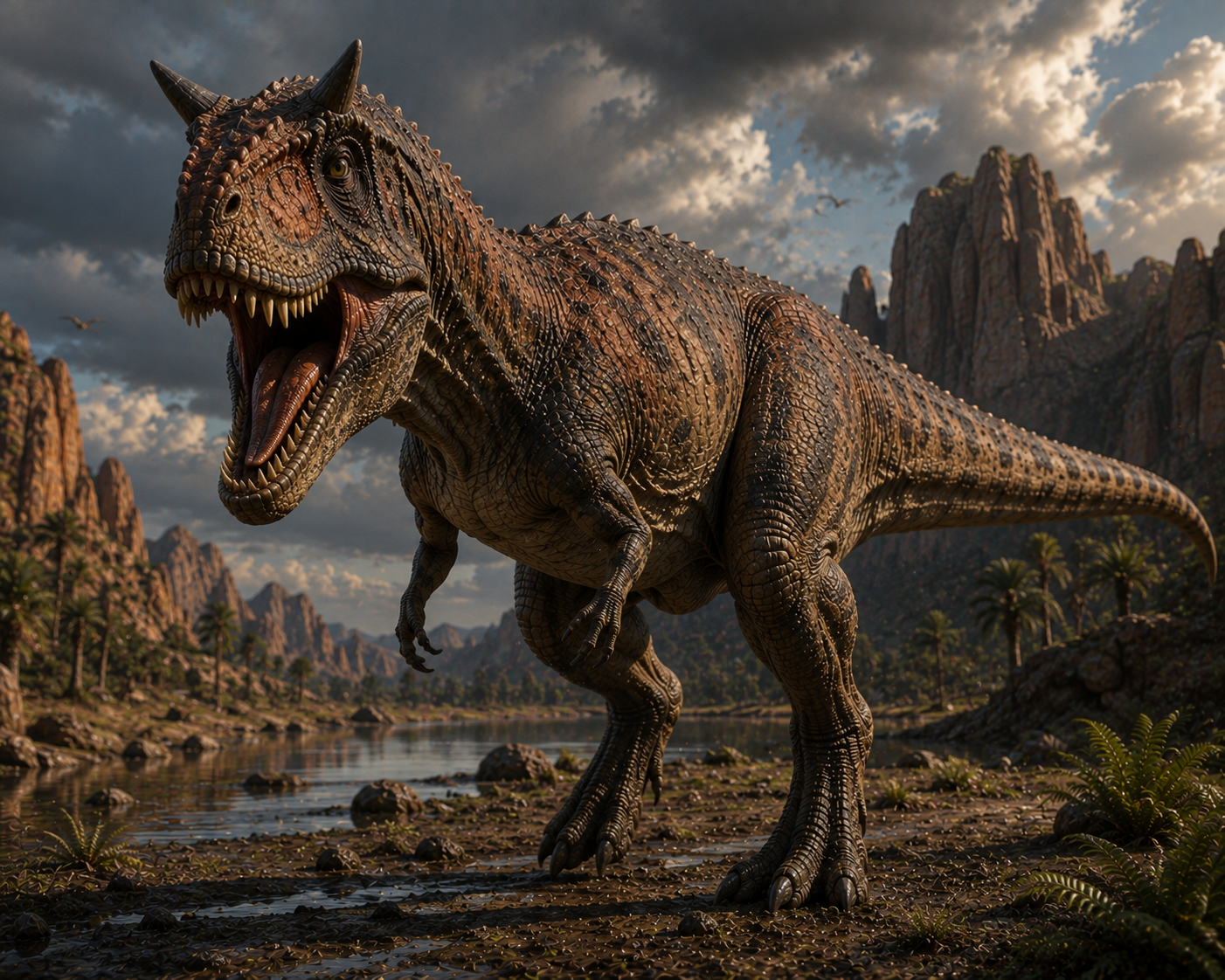
Carnotaurus
Carnotaurus sastrei
Paleobiological Overview & Profile
The cheetah of Cretaceous South America. Carnotaurus is famed for its distinctive bull horns, tiny vestigial arms, and colossal tail-to-leg musculature that turned it into a high-speed pursuit predator.
The Carnotaurus holotype included remarkable fossilized skin impressions showing non-overlapping pebbled scales and rows of larger conical studs along its sides.
True Biological Size Comparison
Anatomical Weapon Systems
Specialized biomechanical adaptations evolved for predatory dominance and defensive survival.
Thick, triangular bone cores situated above the eyes.
Tail muscle weighing up to 15% of total body mass.
Light skull designed for fast closing speed rather than prolonged crushing.
Complete Weapon Systems:
- ✓Two thick forward-projecting brow horns for headbutting
- ✓Massive caudofemoralis muscle delivering 48-55 km/h sprint velocity
- ✓Rapid-action snap bite jaw mechanics
Tactical Combat Playbook
Predatory strategies and survival mechanics against varying classes of prehistoric opponents.
Uses blitzkrieg speed to deliver rapid hit-and-run bites, evading counter-attacks through sheer acceleration.
Avoids heavy armor head-on; targets unarmored limbs with rapid snapping bites.
Outruns prey in straight-line sprints, ramming them with brow horns.
Key Biological Advantages
- +Fastest large theropod on record (top sprint speed over 50 km/h)
- +Bull-like headbutting capability to stun prey
- +Rapid-action snap bite jaw kinematics
Tactical Weaknesses
- -Extremely vestigial, useless forelimbs
- -Poor high-speed turning radius due to rigid tail musculature
Pop-Culture Myth vs. Scientific Evidence
"Popular media often gave it chameleon-like camouflage abilities."
No scientific evidence for camouflage; it was built for pure open-field sprint pursuit.
Combat Rating Index
Habitat & Diet Specialization
Open coastal plains, semi-arid estuaries, and tidal flats of Patagonia.
Hunted fast-running small-to-medium ornithopods and juvenile sauropods.
Discovery Provenance
- Fossil Localities
- Argentina
- First Excavation
- 1984 AD
- Primary Formation
- La Colonia Formation (Patagonia)
- Geological Epoch
- Late Cretaceous