
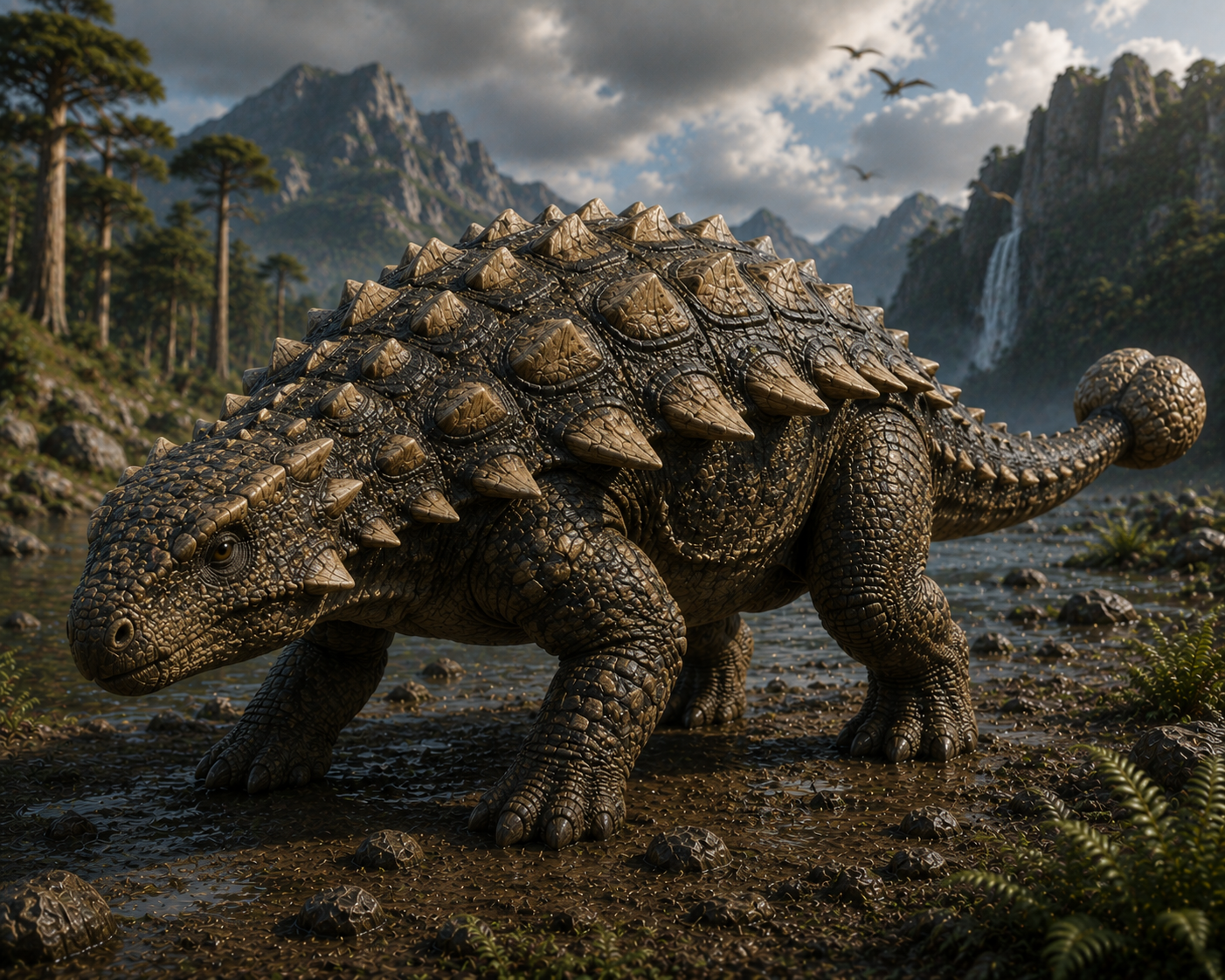
Ankylosaurus
Ankylosaurus magniventris
Paleobiological Overview & Profile
The living battle tank of the Cretaceous. Ankylosaurus was covered from head to tail in thick bony armor plates (osteoderms) and possessed a massive bone club at the end of its fused tail capable of breaking the tibia and ankles of any apex predator.
Biomechanical engineering studies calculate that a full-power tail club strike from Ankylosaurus generated enough force to crush modern automotive steel and shatter a T-Rex’s ankle bone instantly.
True Biological Size Comparison
Anatomical Weapon Systems
Specialized biomechanical adaptations evolved for predatory dominance and defensive survival.
Composed of two large lateral osteoderms and a central medial plate fused tightly to the tail tip.
The last 7 tail vertebrae were fused solid by bony tendons, turning the tail handle into a rigid baseball bat.
Even the skull bones were fused together, including armored plates that protected the eyes.
Complete Weapon Systems:
- ✓Heavy terminal tail club formed of fused osteoderms and rigid vertebrae
- ✓Continuous carapace of interlocking osteoderm bone armor plates covering back and skull
- ✓Thick squamosal and jugal horn-like plates guarding eyes and ears
Tactical Combat Playbook
Predatory strategies and survival mechanics against varying classes of prehistoric opponents.
Locks into ground-level defense, waiting for predator to step into striking range before unleashing maximum-force tail club smashes to legs and ribs.
Uses tail swings to establish spatial dominance and deter rival herbivores.
Wide sweeping tail maneuvers that create a 3-meter no-entry hazard zone around its perimeter.
Key Biological Advantages
- +Near-impenetrable dorsal armor that resists even 12,800 PSI bites
- +Bone-shattering tail club strike generating over 14,300 Newtons of kinetic impact
- +Ultra-low center of gravity anchored by four sturdy pillar legs
- +Immune to frontal and aerial bite attacks on its back
Tactical Weaknesses
- -Soft unarmored underbelly if flipped upside down
- -Slow locomotion sprint speed (cannot outrun faster theropods)
- -Limited vertical strike height (tail club operates mostly between 0.3m and 1.5m off ground)
Pop-Culture Myth vs. Scientific Evidence
"Depicted as passive targets waiting to be flipped over."
Its tail was weaponized with ossified tendons that acted like a steel spring, allowing it to strike repeatedly with pinpoint destructive accuracy.
Combat Rating Index
Habitat & Diet Specialization
Open floodplains, scrublands, and semi-arid subtropical woodlands.
Low-browsing herbivore consuming roots, tough shrubs, low ferns, and fallen fruits using small leaf-shaped teeth and a broad digestive fermenting gut.
Discovery Provenance
- Fossil Localities
- United States & Canada
- First Excavation
- 1906 AD
- Primary Formation
- Hell Creek & Scollard Formations
- Geological Epoch
- Late Cretaceous